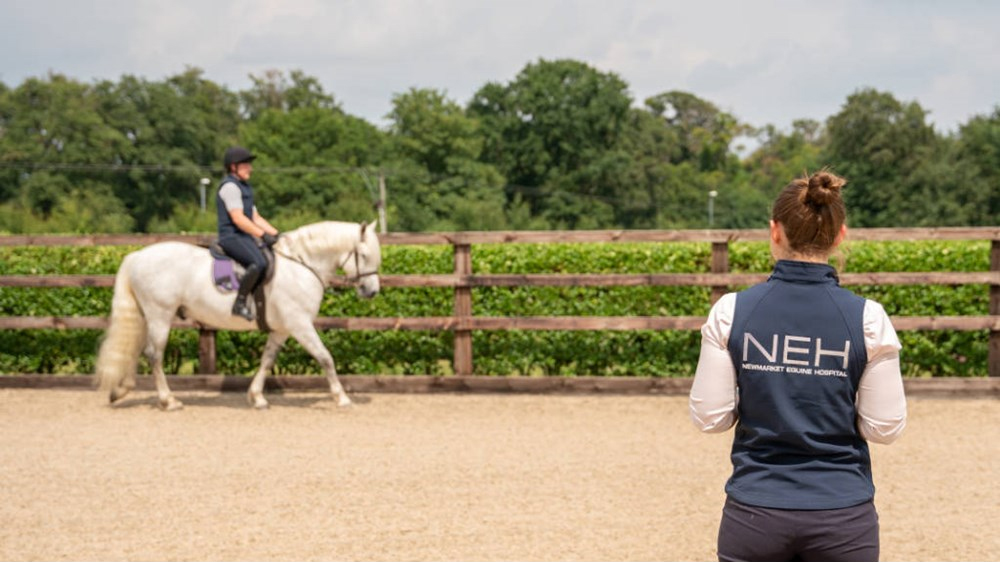
We understand the frustrations involved when a horse’s ability to perform at expected levels is impaired. Our experienced clinicians can systematically assess the potential causes and advise on treatment.
Lameness is one of the most common causes of poor performance and time off work. Varying severities of lameness are common in all types of horse, ranging from obvious at walk, through to much more subtle signs. The priority in all cases is to identify and treat the underlying cause. Horses and ponies referred to NEH will undergo a thorough clinical evaluation including observation at the walk and trot, lunged on both soft and hard surfaces and, when appropriate, a ridden assessment. In some cases, these procedures will be sufficient to determine the source of lameness. However, many others will require further in-depth investigations such as nerve blocks to reveal this. Once the site of lameness has been localised, diagnostic imaging techniques such as radiography, ultrasound and MRI scanning are used to characterise the cause of lameness fully.
There are many other causes of poor performance in the horse in addition to lameness. Reduced levels of performance may be caused by one, or a combination of problems. Musculoskeletal pain (other than those causing lameness) are common contributors, but other body systems may equally be involved, such as the respiratory, cardiovascular or gastrointestinal systems. Some examples include breathing difficulties, cardiac arrhythmias and gastric ulcers to name just a few.
Our consultants have a wealth of expertise and clinical experience, together with the most advanced diagnostic imaging equipment available. These include nuclear scintigraphy, digital radiography, ultrasonography, MRI, video endoscopy and overground endoscopy. When necessary, samples can be sent to our on-site laboratory, ensuring the provision of rapid and accurate results.
Orthopaedics is the largest surgical discipline at NEH and concerns principally joints and bones, with the most common procedures including arthroscopic surgery and fracture repair.
Internal Medicine
Conditions treated by our internal medicine team include diseases of the airways, heart, intestines, liver, kidneys and circulatory system.
Soft Tissue Surgery
The major disciplines in equine soft tissue surgery include abdominal (colic) surgery, airway, and urogenital surgery.
Colic
Colic is one of the most common surgical emergencies in the horse, and success revolves around a highly trained rapid response team.
Wind Surgery & Breathing Problems
Breathing problems are a surprisingly common cause of poor performance in the horse.
Diagnostic Imaging
Diagnostic imaging is a term used to describe methods which allow us to visualise structures and activities inside the body.
Lameness & Poor Performance
We understand the frustrations involved when a horse’s ability to perform at expected levels is impaired. Our experienced clinicians can systematically assess the potential causes and advise on treatment.
Rehabilitation
An athletic injury can result in a prolonged period out of training with consequential physical restrictions for the whole horse.
Dentistry
Equine dental disease manifests in numerous ways, from difficulty in eating and nasal discharge to more subtle bitting and performance-related issues.
Farriery
Consultant farrier Will O’Shaughnessy holds the Worshipful Company of Farriers (WCF) Diploma in Farriery
Covering all aspects of racing work – we care for thoroughbreds in training in and around Newmarket from the day they enter pre-training to the day they leave the yard.
Breeding Services
Our team of stud vets provide comprehensive reproductive and stud medicine services for stud farms in Newmarket and further afield.
Sales
A team of experienced sales vets provide both vendor and purchaser services both privately and at all the major European Sales and many in the USA.
Sport & Leisure
Our Sport and Leisure vets provide a high quality and personalised service to the whole equine community from high end competition horses to your much-loved horses, ponies or donkeys.
Free Visit Rounds
Find out more about our free visit rounds.
Exports
Newmarket Equine Hospital has a dedicated shipping department which specialises in organising pre-export examinations and testing schedules to comply with the differing import requirements to enable horses to travel to countries all around the world.
Endurance
Our lead Endurance vet Tom is involved with the discipline at all levels.
Insurance & Expert Opinion
We have a number of vets who can offer expert opinions for insurance and legal cases.
Surgical Residency – Royal Veterinary College, University of London 2010-2013
Will returned to the Newmarket Equine Hospital on completion of his surgical residency to join the referrals team and specialise in equine surgery. In February 2014 Will successfully passed the qualifying examinations of the European College of Veterinary Surgeons, becoming a Diplomate of the college and gaining recognition as a European Specialist in Equine Surgery.
Will has published several papers in peer reviewed scientific journals and presented both nationally and internationally, on subjects including soft tissue injuries to the tarsocrural joint and sinus surgery.
Prior to embarking on his veterinary career Will was a keen event rider, unfortunately Will no longer competes but still finds time to ride.
Matt Chesworth
Specialist Specialist in Surgery
BVM BVS MVetMed Dipl. ECVS MRCVS
Matt graduated from Nottingham University Veterinary School in 2011. He then undertook an internship before spending 4 years as an ambulatory vet in a busy equine hospital in Yorkshire. Following this, he completed a surgical Residency at the Royal Veterinary College where he developed a keen interest in both soft tissue and orthopaedic surgery. He joined NEH in 2019. In February 2020 Matt successfully passed the qualifying examinations of the European College of Veterinary Surgeons, becoming a Diplomate of the College and a European Specialist in Equine Surgery.
Gaynor Minshall
Director
Specialist
Specialist in Diagnostic Imaging
BVSc Cert ES(Orth) Dipl.ECVDI MRCVS
Gaynor graduated from the University of Bristol in 1998 and following an internship and experience in first opinion practice joined the referrals team headed by Ian Wright in 2002. She gained the RCVS Certificate in Equine Surgery (Orthopaedics) in 2007 and became a partner at Newmarket Equine Hospital in 2011. Following the European College latterly developing a large animal track residency in Diagnostic Imaging, Gaynor achieved Diplomate status in Veterinary Diagnostic Imaging in 2019 and is a RCVS and EBVS recognised specialist in Veterinary Diagnostic Imaging.
Rohan graduated from the university of Glasgow in 2026 and joined NEH shortly afterwards. He is excited to develop in both clinical skills and knowledge during the internship. Rohan’s particular areas of interest are in racing, lameness and surgery.
Jess graduated from the University of Liverpool in 2025 and joined NEH shortly afterwards. Jess is very excited to continue her training at NEH and has a particular interest in surgery and sports medicine.
Jeremy Allen
Associate Director
BSc VetMB MRCVS
Jeremy qualified as a vet in 1998 from Cambridge University having previously done a degree in Animal Science at Nottingham University.
He enjoys all aspects of equine practice, especially sport and leisure horse veterinary work and equine dentistry. He is normally accompanied by his trusty canine companion, Ricky (from Romania) while out on his visit rounds.
He is a keen polo player in his spare time and loves breeding and training young ponies.